Race to Artificial Unintelligence at Sea
The rise of rigid protocols at sea is diminishing seafarers' skills and autonomy, turning them into mere operators of automated systems.

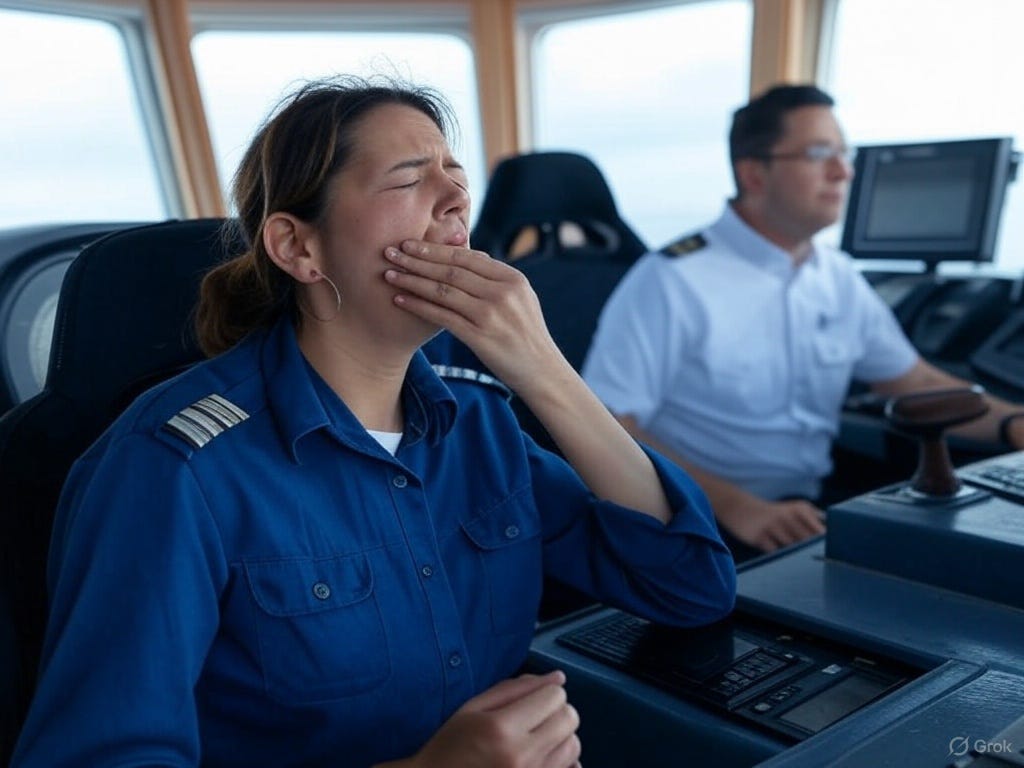
Across the world, the study and pursuit of Artificial Intelligence (AI) races forward, promising ever smarter systems, sharper decisions, and a future where human potential is amplified by technology. Yet at sea, a different force reigns, the pursuit of Artificial Unintelligence (AU).
This is the creeping malaise that transforms skilled, intelligent seafarers into animate cogs—stripped of autonomy, overburdened by protocol, and broken by a system that prioritises compliance over all, which sees competence as a goal and has little room for the pursuit of excellence.
Far from the cutting edge, maritime labour languishes in a paradox where policies, procedures, and Minimum Safe Manning (MSM) certifications conspire to erode decision-making, inflate workloads, and reduce human beings to husks of fatigue, stress, and mental collapse. This is no accident; it is the predictable outcome of a multi-decade drift toward efficiency at the expense of humanity.
Defining AU: The Dehumanising Machine
Artificial Unintelligence isn’t a technology—it’s a condition. It is the process by which seafarers, highly trained and skilled navigators and engineers, are shackled by rigid Safety Management Systems (SMS) and MSM frameworks that dictate every move while ignoring real-world demands.
Under AU, autonomy evaporates; decisions once made by experienced mariners are outsourced to checklists and logbooks, enforced by distant bureaucrats or profit-prioritising owners. We are in danger of a system, if not already here, where seafarers don’t think—they comply. They don’t adapt—they endure. And when the system’s cracks widen—with too few people to do too much work—they break.
AU leaves no room for resilience. The Seafarers Happiness Index tracks a grim rhythm: fatigue, isolation, and mental strain pulse through crews stretched beyond limits. Studies pin 15-20% of maritime incidents to exhaustion, a statistic that barely scratches the surface of unreported burnout.
AU thrives here, turning the simplest tasks of living at sea, watchkeeping, maintenance, a moment’s rest—into Herculean labours, all while MSM certificates nod approvingly: “All is well. Nothing to see here.”
The Erosion of Autonomy: Descent of Decades
Rewind to the 1980s. Ships still carried echoes of an older era—larger crews, manual systems, and a reliance on seafarer judgment and whisper it, skill. Technology—containerisation, automation, radar—promised efficiency, and it delivered, but at what cost?
A vessel that once needed 40 hands could sail with 15, then 12, then 10. Shipowners rejoiced; costs plummeted. But as crew sizes shrank, so did discretion, and the loss of wriggle room. The International Safety Management (ISM) Code, rolled out in the 1990s to build a real link to operating companies ashore, layered on SMS protocols to standardise safety, which noble in theory, it calcified in practice.
Then, as every action became scripted, checked and check-listed, every deviation a non-conformity, real intelligence eroded. Meanwhile, MSM, set a “minimum” crew benchmark that owners treated as a ceiling, not a floor.
Technology did not just reduce headcounts; it shifted power. Where the Master once reigned, now the SMS and MSM dictate a rigid dance to the tune of a distance manager or executive, decisions made in luxurious shorebased isolation.
On watch, off watch, extra work, port calls, cargo care, hold cleaning, passenger needs, delete as appropriate, rinse and repeat, with maintenance and drills squeezed into “rest.” Autonomy withered as seafarers morphed from trusted decision-makers into executors of orders, their expertise sidelined by a system that trusts, nay needs, paperwork over people.
MSM and SMS: The Twin Pillars of AU
MSM was meant to ensure safety—a crew size to handle navigation, emergencies, and upkeep. But it’s static, a snapshot of theoretical need and rhetorical risk, not dynamic reality. A ship with a “minimum safe” crew might run smoothly until a storm hits, a pump fails, some containers lashed or a port demands a fast turnaround.
No buffer, no slack—just relentless pressure on a few shoulders. Alas all too many Owners and managers lean on MSM not because it is safe, but because it’s cheap, backed by flag States racing to offer the leanest certificates. The Nautical Institute, World Maritime University and so many more experts warn that understaffing amplifies fatigue, yet MSM stays a rubber stamp, not a safeguard.
The SMS, paired with MSM, doubles down on AU. It’s a compliance machine—checklists to prove “safety” while workloads balloon. A seafarer logs rest they never get, not out of dishonesty, but survival; honest records risk delays or penalties.
The system aligns perfectly on paper: MSM says “X” crew suffice, SMS says procedures are followed, and the ship sails. In reality, those minimum safe few are drowning—long demanding days and nights, split rest, no margin for error. AU thrives in this gap as humans quietly fracture.
Under AU, seafarers are not just overworked—they’re dehumanised. Their labour (and value) reduced to data entries which disconnect the human effort and endeavour from meaning or reward. Absurdism adds bite—the pretence of safety clashes with a futile Sisyphean farce where the rolled rock of compliance constantly slips back down the hill of exploitation.
Mental health breakdowns, sickness, stress, and fatigue-driven errors aren’t outliers; they’re the new rhythm of life at sea. This Maritime Möbius Strip twists on: more crew raises costs, so logs are fudged as honest data exposes overwork, thus manning stays low. This seemingly simple loop comes with an endless complexity trapping seafarers in a cycle where every solution bends back into a problem. No exit, just endless strain.
Contrast this with AI’s promise—systems that learn, adapt, optimise. At sea, AU inverts that: seafarers’ natural intelligence is stifled, their adaptability crushed by protocol. AU doesn’t enhance—it enslaves.
To break AU’s grip, we must ditch the delusion of borrowed excellence within compliance and embrace the need for respect and recognition, of both problems and solutions. Change has to come, AU has turned seafarers into cogs and standards into shackles; only a rebellion of wisdom can set them free. The sea deserves better than artificial unintelligence—it’s time to be driven by proper thought, with intelligence at the fore, whether in a head, heart or even machine.